Why Financial Literacy Should Start Before High School: Building Wealth Early
Why Financial Literacy Should Start Before High School
For many adults, the first time they truly think about money is when they begin paying bills, taking out student loans, or starting their first job. By that time, financial decisions already carry real consequences.
But what if we could change that timeline?
What if young people began learning how money works years before they ever had to depend on it?
At Young WallStreet, that's exactly what we believe and exactly what we're working to do.
Financial literacy works best when it starts in middle school or earlier, giving young people years of exposure to concepts like investing, ownership, and wealth-building before they face real financial decisions.
Financial literacy is not just about budgeting or saving spare change. It's about understanding opportunity, ownership, and the systems that shape economic mobility. And the earlier those lessons begin, the greater their impact.
What Are Schools Missing in Financial Education?
Despite the importance of financial education, most students graduate high school having never learned how to:
Evaluate an investment
Understand compound growth
Analyze how companies make money
Think like an owner instead of just a consumer
This gap has real consequences.
Without financial literacy, young people enter adulthood navigating complex financial decisions without the tools to succeed. Credit, investing, entrepreneurship, and wealth building all become intimidating rather than empowering.
The truth is simple: financial confidence doesn't appear overnight; it develops through exposure and practice.
And that exposure should start long before adulthood.
Why Starting Early Changes Everything
Children are naturally curious. They ask questions about how things work, including how money works.
When we introduce financial literacy early, something powerful happens.
Students begin to see money differently.
Instead of viewing money as something mysterious or stressful, they begin to understand it as a tool, one that can be used thoughtfully to create stability, opportunity, and independence.
Learning about financial concepts early also changes how young people think about the world around them.
A student who studies how companies operate doesn't just see a brand; they see a business model.
A student who understands investing doesn't just spend money; they think about ownership.
These shifts in perspective are small at first, but they compound over time, shaping how young people approach decisions throughout their lives.
Why Should Financial Education Teach Ownership, Not Just Income?
One of the most important mindset shifts we teach at Young WallStreet is the difference between earning money and building wealth.
Most people are taught to focus on income: working, saving, and managing expenses.
But wealth-building involves something deeper. It involves ownership.
Ownership means understanding how assets work, how investments grow over time, and how financial decisions can create long-term stability.
When students learn these concepts early, they begin to see possibilities that might otherwise remain invisible.
They start asking different questions:
What companies do I believe in?
How does investing work?
How can I grow my money over time?
These questions open doors to a completely different financial future.
What Role Do Programs Like Young WallStreet Play in Financial Education?
Programs like Young WallStreet exist to provide students with access to financial education that many schools simply cannot offer.
Through hands-on learning, investment simulations, and real-world exposure to the financial world, students gain practical skills that make money feel understandable rather than intimidating.
They learn that wealth building is not reserved for a select few; it is a skill that can be taught, practiced, and developed.
And perhaps most importantly, they learn that their financial future is something they can influence.
Why Does Early Financial Education Last a Lifetime?
Every lesson taught today is a seed planted for tomorrow.
A student who learns about investing at thirteen may carry that knowledge into college, their first job, and eventually their own family.
Those early lessons become habits. Those habits become confidence. And that confidence becomes independence.
This is why financial education matters so deeply.
It is not simply about money. It is about opportunity, empowerment, and possibility.
And when we begin early, the possibilities grow even greater.
Fund a Child. Fund Independence.
Expanding access to financial education requires community support. Many students who would benefit from programs like Young WallStreet do not have access to these opportunities without sponsorship.
When you help fund a student's participation in financial literacy education, you are doing more than supporting a program. You are helping plant the seeds of confidence, independence, and long-term opportunity. And those seeds can grow for generations.
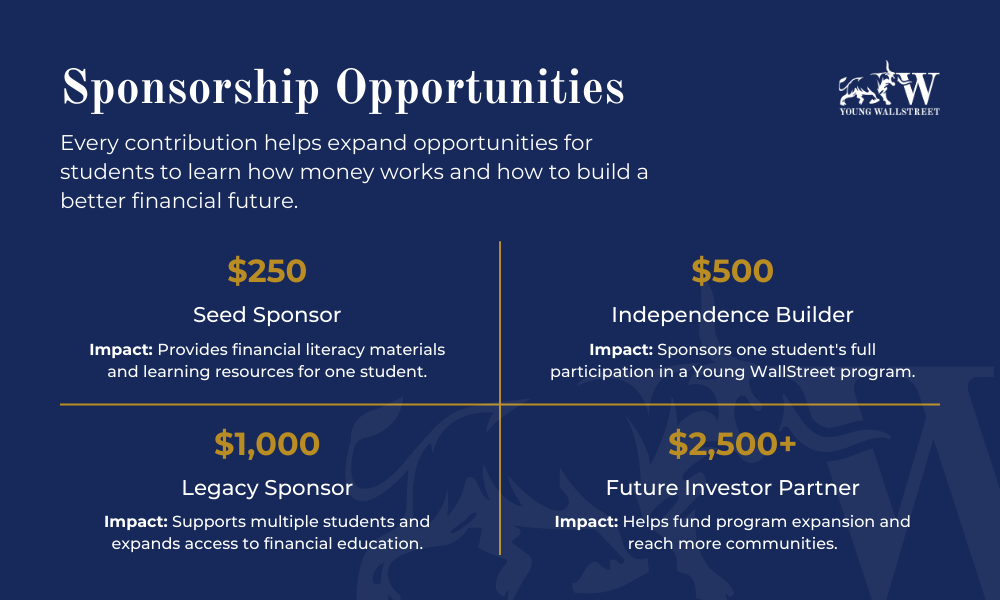
Every contribution helps us expand opportunities for students to learn how money works and how to build a better financial future.
Fund a Child Today
Click here to learn more about how to Fund a Child and expand financial education opportunities today.